Frozen Pitches and Four-Game Weeks: How Charlton Women Cope When the Calendar Turns
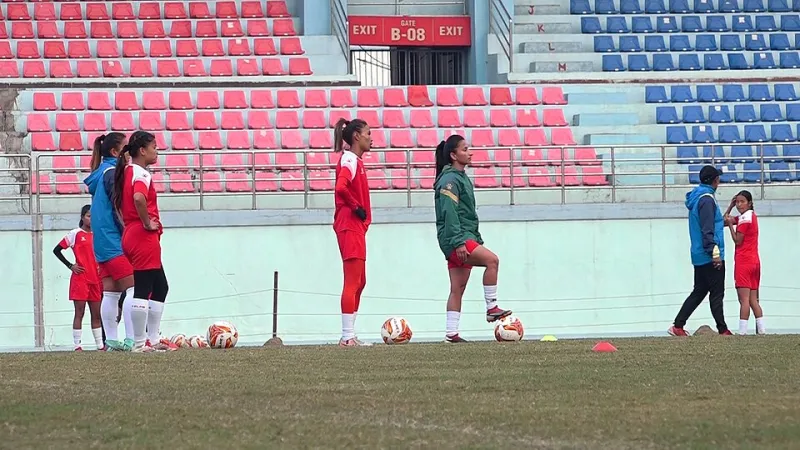
Photo: Gunjan Raj Giri, CC0, via Wikimedia Commons
There is a stretch in every women's football season that nobody puts on a poster. It starts around now, in the cold and the dark, and it runs through to the far side of January. The pitches get heavier. The fixtures bunch together. The treatment room gets busy. And the table starts to bend in ways that will not be obvious until April.
At Charlton Women, this is the bit of the calendar that staff talk about with a kind of wary respect. Not dread — respect. Because winter does not reward the best team. It rewards the best-organised one.
The Calendar Doesn't Ask Permission
A congested run is not simply 'more games'. It is a different logistical problem. A Sunday–Wednesday–Sunday sequence means the recovery day between match one and match two is not a recovery day at all, it is a travel-and-prep day. Sessions get shorter. The work shifts from loading to maintaining. The pitch at the training ground, already softer than it was in September, becomes a variable nobody fully controls.
'You plan the week backwards from the fixtures, not forwards from Monday,' one member of the coaching staff explains. 'If you've got three games in eight days, you're not coaching the same things you'd coach with a clear week. You're choosing. Every session you're choosing what to leave out.'
That choosing is where winter is won and lost. Coaches talk about 'banking' — keeping enough in the legs for the third game rather than emptying the tank in the first. It looks, from the stands, like a team playing within itself. It usually is.
Frozen Pitches and the Rewritten Training Week
Frozen ground is its own small crisis. Grass sessions get moved, shortened or cancelled. Indoor space is limited and shared. Gyms fill up. Small-sided games on a harder surface change the injury risk profile, so the sports science staff start making calls they would rather not make.
What supporters rarely see is how much of winter training becomes improvisation with a plan attached. A session might move indoors and become twenty minutes of mobility, twenty of possession work in a confined space, and a long video block. It is not glamorous. It is, several staff members insist, where sides quietly improve — because video work does not care about the weather.
Then there is the ball. A cold, heavy ball travels differently. It stings on the laces. It behaves oddly off a frozen surface. Players who have spent autumn drilling crisp passing patterns have to accept a slightly scruffier game, and defenders who like to play out have to be honest about when to go long.
Rotation Isn't Rotation Anymore
The word 'rotation' gets used lazily. In a congested spell, it is less about resting players and more about managing minutes across a group. That means substitutions at 55 minutes rather than 75. It means a starter becoming a finisher. It means a player who expects to play every week being told, kindly but firmly, that she is playing 60 today and 90 on Wednesday.
It also means opportunities. Winter is when squads find out what they have. A fixture pile-up will hand starts to players who were on the fringes in October, and those players either take the chance or they do not. Supporters should pay attention to who is trusted in the third game of a run — that is often the clearest signal of what the coaching staff really think.
Illness Season
Here is the least discussed factor in winter form: bugs. A dressing room is a shared space, and shared spaces share germs. One player goes down on Tuesday, two more feel rough on Thursday, and by Saturday the team that was picked on Wednesday is not the team that runs out.
Clubs handle it with a mixture of hygiene protocols, early isolation and a certain amount of stoicism. But it is a genuine variable, and it is one reason why a result that looks inexplicable in isolation can make perfect sense in context. If half a midfield has spent the week in bed, a flat performance is not a mystery.
What to Watch for Beyond the Scoreline
If you want to read a winter performance properly, look past the result for a moment and watch a few specific things.
The bench and the timing of changes. Early substitutions in a congested run are not panic. They are the plan.
The last fifteen minutes. Winter games at this level are frequently decided by which side has managed its legs better. A team that is still pressing in the 85th minute in January has been looked after.
The warm-up. Longer, more structured warm-ups are a sign of cold-weather management. If the players disappear down the tunnel later than usual, that is not disorganisation.
The team news. Unusual absences at short notice in December are more likely to be illness than selection. It is worth remembering before reaching for conclusions.
The style of play. Direct football in a strong wind on a heavy pitch is not a philosophical retreat. It is a sensible response to conditions.
The Quiet Importance of January
There is a temptation to treat January as a month to survive. Coaches rarely do. Points collected in the cold are worth exactly the same as points collected in April sunshine, and the sides that go on to have good seasons tend to be the ones that did not write off the awkward months.
For supporters, that means a bit of patience with performances that look scrappy, and a bit of attention to the things that do not show up in a scoreline — who is available, who is being managed, who is getting minutes. The winter table is not the final table. But the habits formed in it usually are.