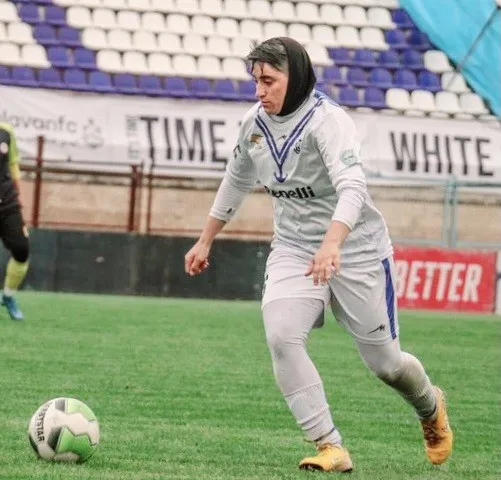
Ours Now: How Charlton Women Are Writing Their Own Chapter at The Valley

Photo: David Jane Footballer, CC BY-SA 3.0, via Wikimedia Commons
Every football club has its mythology. The games that live forever. The goals that get retold across generations with details that shift slightly each time until they become something closer to legend than memory. The Valley has plenty of those stories — decades of them, layered into the stands, worn into the concrete, embedded in the language fans use when they talk about what this club means.
Charlton Women are not here to compete with any of that. They're here to add to it.
That distinction matters more than it might initially seem. There's a version of women's football development that positions itself in permanent relation to the men's game — always explaining itself through comparison, always measuring progress against a male benchmark. Charlton Women, increasingly, are choosing a different approach. They're not building a shadow programme. They're building something that stands entirely on its own terms, in the same space, under the same badge, with its own emerging mythology.
Claiming the Ground
The Valley is a particular kind of football ground. It doesn't have the sleek anonymity of a new-build stadium. It has character — proper, slightly inconvenient, occasionally draughty character. And when Charlton Women play there, something shifts in how the space feels.
For supporters who've watched women's football grow at this club over the years, there's a before and after to how The Valley registers during a women's game. The before was a sense that you were borrowing something — a ground designed for a different purpose, accommodating you generously but not quite on your terms. The after — and many fans place this shift at different moments, different games — is when it started feeling like home.
"There's a moment in a match when the crowd gets into it and the ground responds," says one long-standing Charlton Women supporter. "The acoustics change. And I remember the first time I felt that at a women's game and thought — this is ours. This isn't borrowed. This is ours."
That sense of ownership isn't incidental. It's been cultivated deliberately — through matchday experiences designed to build community, through consistent communication that treats women's football as the main event rather than a supporting act, and through the players themselves developing visible, genuine relationships with the people who show up for them.
Rituals in the Making
Every club's culture is built from rituals, and the most powerful ones are the ones that begin organically and then calcify into tradition. Charlton Women are in the middle of that process right now — which makes this a genuinely fascinating moment to be paying attention.
Pre-match routines that started as practical necessities have evolved into something more ceremonial. The way certain songs now get adopted by the stands without any top-down coordination. The particular atmosphere that builds in the final twenty minutes of a tight game, and the specific way it sounds when the net moves. These are the raw materials of mythology.
"I think what's happening is that we're creating memories together," says one Charlton Women player. "And memories become stories. And stories become part of what the club is. Five years from now, ten years from now, people are going to talk about this period. I genuinely believe that."
The club has been thoughtful about reinforcing these emerging traditions without over-engineering them. There's a fine line between fostering culture and manufacturing it, and organisations that try too hard to create organic moments tend to produce something that feels hollow. What's happening at Charlton Women feels like the real thing — imperfect, growing, occasionally chaotic, and entirely genuine.
Standing Alongside History
Charlton Athletic's most famous story is the exile and return — the years playing away from The Valley, the campaign to come home, the emotional reopening in 1992. It's a story about belonging, about a community's refusal to accept displacement, about what a football ground means to the people who love it.
Charlton Women have their own relationship with belonging. A different kind — not about physical exile but about cultural space, about being taken seriously, about the slow, sometimes frustrating work of establishing that your football matters as much as anyone else's.
The two stories don't compete. They rhyme.
"When I think about what this club stands for," reflects one Charlton Women coach, "it's always been about community. About people fighting for something they believe in. The women's programme is completely part of that. It's not a different story. It's the same story told by different people."
That framing — same story, different voices — is perhaps the most elegant way of understanding what Charlton Women are building. They're not trying to replicate men's football's legacy or overshadow it. They're extending the narrative. Adding chapters. Giving the story new characters and new moments that will one day be told with the same weight as anything that came before.
The Players Who'll Be Remembered
Legacy, in football, ultimately attaches itself to people. The goals, the seasons, the trophies — they exist in relation to the players who produced them. And Charlton Women are in the process of establishing their first generation of figures who will be remembered.
Not just for what they did on the pitch, but for who they were in the context of the club's development. The ones who were here when things were being built. Who showed up consistently, who gave the younger players something to aim for, who helped establish what it means to be a Charlton Women player.
"I want to be someone the academy girls look up to," says one Charlton Women forward simply. "I want them to see me and think — that's what it looks like to commit to this club. That's what it looks like to care."
That's how legacies begin. Not with monuments or retrospectives, but with someone deciding to be the standard that others measure themselves against.
The Echo Gets Louder
The Valley's echo — that particular acoustic quality of a crowd getting behind their team in a ground that's been a home for nearly a century — is something Charlton Women are learning to produce on their own terms.
It doesn't sound exactly like it does during a men's game. The crowd is different, the game is different, the atmosphere has its own texture. But it's real. It builds. It carries.
And every time it does, another piece of the mythology falls into place. Another memory is made. Another story begins that will one day be told, with slightly embellished details, to someone who wasn't there.
That's how a legacy gets built. Slowly, loudly, and with enormous love for a game that keeps giving it back.